CHOCOLATE-COVERED STRAWBERRIES!
I had an English teacher who told me that most writers lose their reader within the first paragraph, so you need to start off with a good hook. Did it work?
Anyway, an issue that began two years ago at my alma mater has begun to dominate public discourse at the school (and even in national news). I want to talk about that particular case, but I also hope to address the deeper societal illness of which this issue is but one symptom. As a culture, we are quickly arriving at a state in which our identity as progressive or conservative defines not only our worldview, but also our relationships, our religion, and our ability to function in community. And I don’t like it.
Let’s start with the non-discrimination issue at Vanderbilt. Basically, two gay students were forced to leave their Christian fraternity due to their sexual orientation, sparking an investigation by the university’s administration. Ultimately, several organizations on campus have been placed on probationary status as their by-laws are reviewed. Bottom line: If those rules in any way require a member or leader of the organization to be of a certain race, sexual orientation, religion, gender, nationality, etc., then away they go (Except for social fraternities which are explicitly permitted to discriminate based on gender, according to Title IX).
In response, some religious organization (and FOX news) cry “violation of religious freedom,” “persecution,” and speak of potential hostile takeovers of religious organizations by malicious gays. On the other side, supportive students applaud the administration for finally guaranteeing basic civil rights to all students, demonizing their opponents as bigoted and medieval.
I honestly see merit in both sides of the 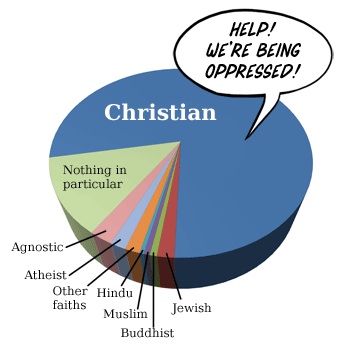 philosophical argument. I do not see merit in the way that both sides have thus far made the argument. Religious organizations in fear of losing their freedom to practice their beliefs are not the devil incarnate; gay people are not going to take over the Fellowship of Christian Athletes; and for goodness’ sake, nobody in the United States has the slightest clue what persecution feels like.
You know what, though? I do not want to talk about the non-discrimination policy at Vanderbilt. And I do not want to discuss the recent outrage over a pretty mild contraception compromise. Or the vicious attacks on President Bush’s character that pervaded his presidency. Or the way that the debate over gay ordination and marriage has torn apart several churches and continues to threaten others. Because all of these issues can be summed up in one word: polarization.
Polarization: When blind shouting and stubborn belief replace reason and cooperation. The “culture wars.” Whatever you want to call it, it is here.
It may be hard to believe, but there was a time (before 1970) when those in Congress would make deals with people of opposing parties – “compromise,” they used to call it. And they did not condemn the other’s entire morality in the process! There was a time when journalists told stories that included all of the facts – not just the ones that boosted their ideological agenda. And religious people used to care more about practicing their religion than practicing their politics.
Then, parties realized they could glean more votes if they rigidly clung to one view on a specific set of issues; news stations found that more viewers would rather watch senseless ranting than learn about current events, and Ronald Reagan single-handedly co-opted evangelical protestantism for the Republican party.
And it’s not just the Republicans – political parties have co-opted our faith. We now have Republicans and Democrats who go to a Christian church, rather than Christians who happen to vote Democrat or Republican.
Clearly, this issue ticks me off. When did it become cool to bury our heads in the ideological sand and try to drown out all arguments that might make us question our opinions? John Wesley explicitly said “We do not have to think alike in order to love alike.” And yet this disease of polarization permeates our entire existence. Did you know that if a liberal person searches for “Barack Obama” on Google, their search will return on average way more positive sites than a conservative’s search? This is because Google now ranks its search results based on the worldview your previous internet habits have revealed you to hold. It helps you sink deeper into the herd mentality that keeps real dialogue from happening.
But how many of us would accept this characterization of our own attitude toward disagreement? Of course, we listen to divergent opinions. We don’t demonize the other side!
OK, then. Ask yourself this: What radio station do you listen to for news? Are you just as comfortable watching FOX as MSNBC? Is it just as easy for you to be friends with a Republican as with a Democrat? If you are a liberal Christian, would you rather hang out with a liberal Muslim or a conservative Christian? Vice versa? Do you care more about who gets elected in 2012 than about whether millions of people starve today?

There is supposed to be a prophetic nature to religion. By prophetic, I mean that it doesn’t choose one side or the other in temporal debates. It doesn’t hitch its wagon to whichever political party can result in the most new members on Sunday. It transcends politics.
The prophet Isaiah did not come to divinely ordain the nation of Judah against foreign invaders – Isaiah asked Judah to reflect on its own behaviors and correct its offenses against God. Those Jesus encountered were constantly trying to make his teachings reflect their preconceived ideas, but time and again he left them with a vision of the world that went far beyond their own imaginations. Martin Luther King, Jr. did not use religion to coerce people into voting for civil rights – he saw a prophetic commandment to guarantee basic human rights that emerged from his religion.
If you are a person of faith, ask yourself: Does my faith determine my ideology, or do I just use my faith to make my ideology seem more credible?
If you are not a person of faith, well, I’m embarrassed to say…you probably aren’t the problem.
 Life Reconciling
Here! Here! Well said Gabe!
Pingback: The War on Sanity, Part 2 | Serve-Learn-Grow