I’m reading a book right now by Mark Twain called How to Tell a Story and Other Essays. In the course of explaining the importance of “the pause” and not laughing at your own punch line, he gives an example from a storyteller named Artemus Ward:
He [Ward] would say eagerly, excitedly, “I once knew a man in New Zealand who hadn’t a tooth in his head” –here his animation would die out; a silent, reflective pause would follow, then he would say dreamily, and as if to himself, “and yet that man could beat a drum better than any man I ever saw.”
As I read it, I so wanted to chuckle to myself and revel in this high humor from an American literary legend. The thing is, I don’t get it. Is he hitting the drum with his head? Is his head actually the head of a drum? What do teeth have to do with it? Seriously, this is tangential to the blog – I just really need someone to explain the punchline to me.
Then again, I’ve always suffered from poor  comedic instincts. I tend to always laugh last at a joke, and my best witty retorts come only after a conversation has long since ended. I get so wrapped up in the deeper implications of discussions that I often fail to grasp the efficacy of using light humor to make a point.
It makes me think about comedy and religion. I think a lot of us were raised with this perception of a church building as “sacred” in such a way that means “without humor or laughter.” In fact, for the longest time I had a superstitious feeling that telling a joke within earshot of a house of worship would most certainly result in a lightning strike – or at least bird poop on my shoulder.
I have definitely grown out of this – so much so that I now struggle with the reverse problem of being too inappropriate in sacred settings. In our Methodist/Episcopal student group at college, we did this thing where we circled up at the end of every worship, held hands, and shared joys and concerns. One night, feeling a little rambunctious during a certain prolonged silence, I cautiously began to speak in my gravest, prayer-request voice, “So, an angel of God appears to Moses in the form of a burning bush. Moses looks at it in surprise, his jaw drops, and he says, ‘No way…’ God replies, ‘Yah Weh.’”
I got mixed reactions from my compatriots. There were a few chuckles and a lot of disappointed head-shakes. I think a lot of it had to with the fact that it was a terrible joke, and the rest that it was terrible timing. Like I said, I don’t think I fully grasp the relationship between comedy and religion.
Maybe some people are just really good at using humor to make a profound point. Mark Twain often did this with scientific precision in his other writings, and I think that’s what was missing from my burning bush joke. The way I see it, a good academic paper can fully explain all of the detailed analyses, solutions, examples, and counterarguments of a given problem. A good story can go further and extract the deeper message in an engaging and provocative way. Perhaps a good joke can get to the honest truth of an issue in a way that nothing else can.
How does humor factor into your faith?
Should religious institutions be somehow shielded from the crass humor of pop culture?
If so, where is the boundary?
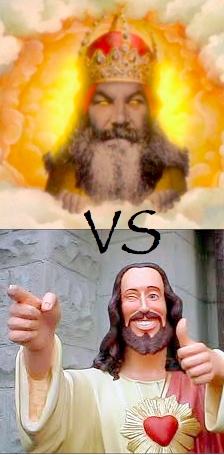
Does your image of God tell a bad joke now and then,
or is it more of an angry King emerging from the clouds?
 Life Reconciling